Heart coherence: what it is and why "knowing it" isn't always enough to change it
If you know what's going on but can't manage to change it, it isn't by chance — nor a lack of willpower. The nervous system has its own way of learning, and heart coherence is one of the ways in to work with it.
What heart coherence is
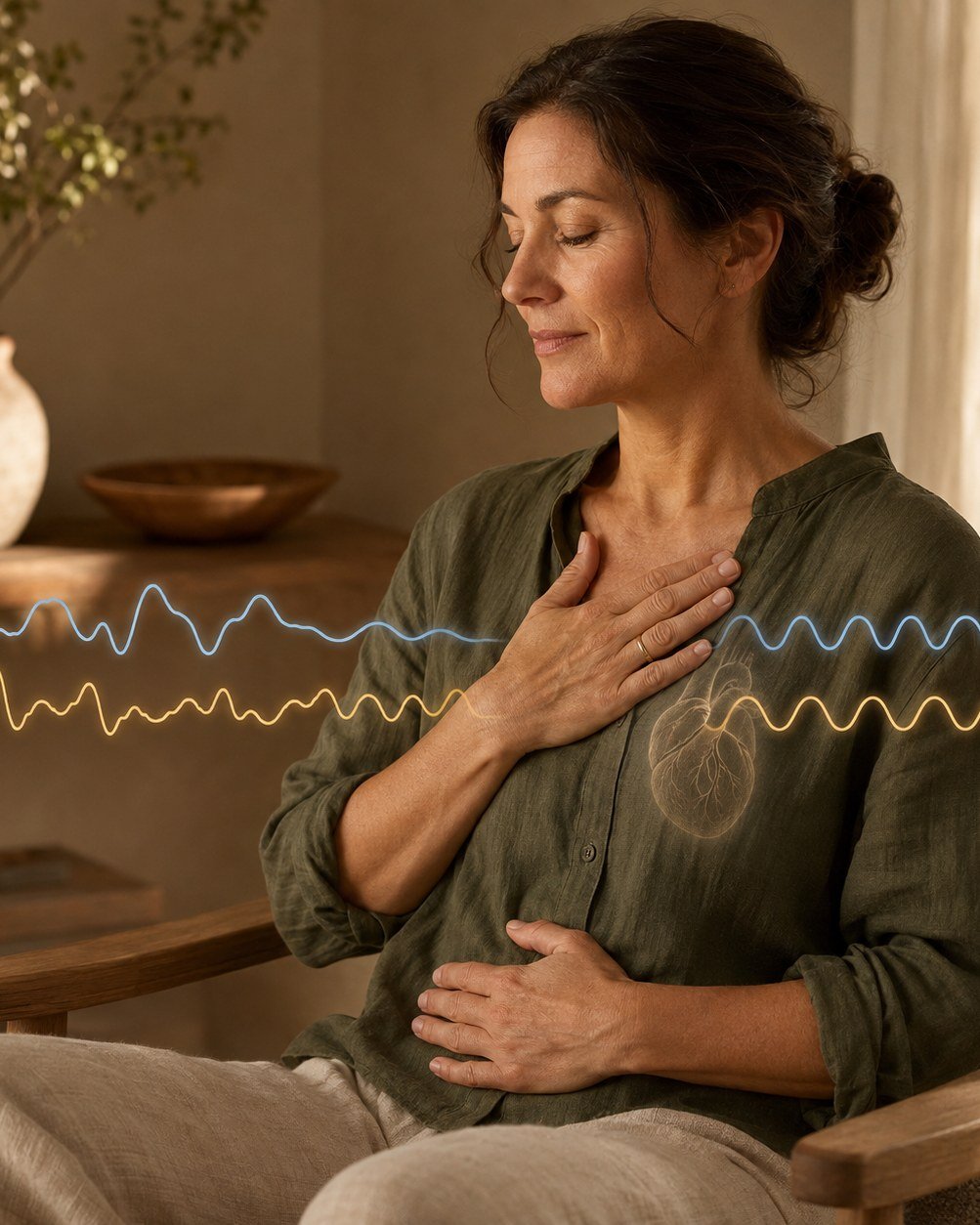
Heart coherence is a physiological state in which the heart rhythm goes from being irregular and erratic to a smooth, wave-like pattern of greater amplitude — what research calls coherent heart rate variability (HRV). It isn't an abstract concept: it can be measured, and it's trained mainly with slow, paced breathing, at around six breaths per minute, combined with calm emotional states.
When the heart enters that coherent rhythm, the autonomic nervous system — the part of the body that regulates the alert response and the calm one — starts to work in a more balanced way. This isn't only a subjective feeling: it's a physiological signal the heart sends to the brain through a two-way communication system, and it influences how we process emotions and respond to what happens to us.
What the research says
Heart coherence and heart rate variability training (known in the scientific literature as HRV biofeedback) have been studied for more than two decades. Two references sum up the current state of the evidence well:
- Goessl, Curtiss and Hofmann (2017), published in Psychological Medicine, analysed 24 studies with 484 participants and found a broad, consistent reduction in self-reported stress and anxiety after heart rate variability training, with a notably large effect size — regardless of the number of sessions or the methodological quality of each study.
- Elbers and McCraty (2025), in Global Advances in Integrative Medicine and Health, review how heart coherence training (the approach developed by the HeartMath Institute) improves stress, anxiety, mood, sleep, cognitive performance and chronic pain after four to six weeks of practice, with benefits that hold beyond the intervention — through greater vagal tone and better synchronisation between the body's different systems.
Why "knowing it" isn't always enough
It's common to come to a session knowing exactly which pattern repeats: the same argument, the same way of avoiding, the same disproportionate reaction. The problem usually isn't information, it's regulation: many of those patterns are held by a nervous system that responds in alert mode before the conscious, rational part has time to step in.
That's why, in the process, we first work on observing the body and the automatic response — of which heart coherence is a good indicator — before asking the mind to "decide" to change. When the nervous system is regulated, there's more real room to observe, understand and choose a different response instead of repeating the usual one.
A simple way to start
You don't need any device to practise a basic version: sit down, bring your attention to your chest or abdomen, and lengthen your breathing to about five or six times a minute (breathe in counting to five, breathe out counting to five), holding it for several minutes. It's a first step — useful as a self-regulation practice, and more powerful when worked on alongside the specific pattern you want to change.
"Understanding is the start. Changing the response is the process."
Want to work on the pattern that repeats?
An individual online session is a good starting point. If you're looking for a more ongoing process, RESET is six sessions designed for that.

 Asociación Caballito de Mar