Heart coherence between horses and people: what the science says
You often hear that a horse's heart "synchronises" ours almost by magic. Part of that idea is backed by real research — and another part is a myth repeated so often that it has started to sound like established fact. Let's separate one from the other.
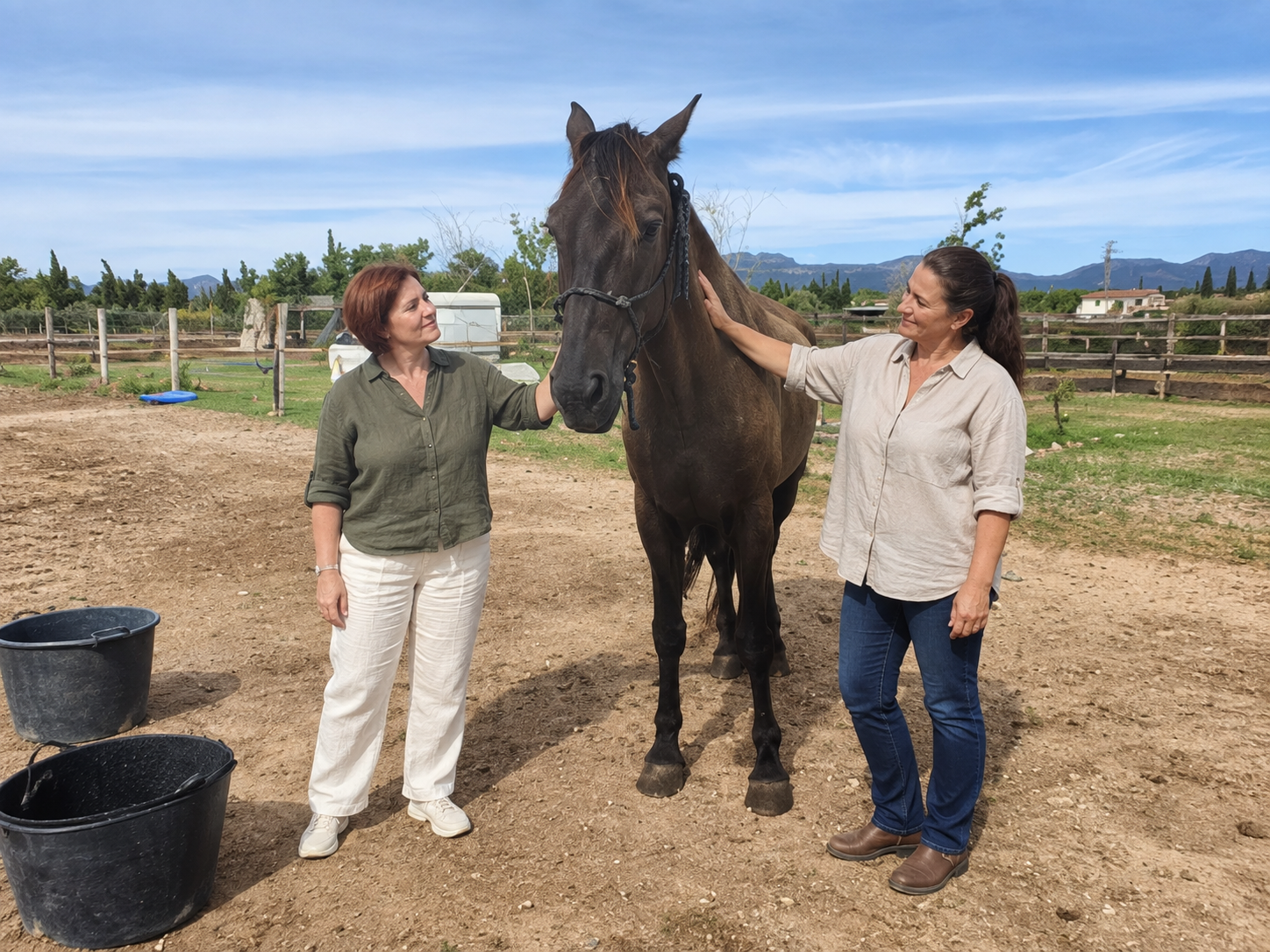
We've already written on the blog about what heart coherence is and why regulating the nervous system is a step before being able to change a pattern. Here we ask something more specific: what happens when that regulation takes place near a horse, and to what extent is what's said about it backed by science?
Why horses are different
The horse is a prey animal, not a predator. That means its nervous system is permanently scanning the environment for signals of safety or threat — including the posture, breathing, rhythm and tension of the people nearby. You don't need any mysterious mechanism to explain why a horse "notices" when someone arrives agitated: it's an animal trained by millions of years of evolution to read the body before the words.
That sensitivity is what makes the horse a good mirror of a person's internal state — not because it "reads minds", but because it responds honestly and in real time to physical signals we often aren't even aware we're giving off.
The myth worth clearing up
It's very common to read that the horse's heart generates an electromagnetic field several times more powerful than the human one, and that this field directly "synchronises" our heart rhythm. This idea comes from a very small pilot study that was never formally published, and later studies that tried to confirm it had tiny samples (one or two people) and results that didn't always support the initial hypothesis.
What peer-reviewed research does show
Setting that particular myth aside, there is a more recent and methodologically more solid body of research on physiological synchronisation between horses and people:
- Naber, Kreuzer, Zink, Millesi, Palme, Hediger and Glenk (2019), in Pet Behaviour Science, measured heart rate, heart rate variability and salivary cortisol in clients with intellectual disability, their therapists and the horses during assisted-intervention sessions. They found significant correlations in heart rate among the three parties, stronger the greater the familiarity between the client and the specific horse.
- Wienhold et al. (2024), presented at the Psychologie und Gehirn conference (University of Konstanz), analysed heart rate variability synchronisation in the patient-horse-therapist triad in 43 participants. The central finding: synchronisation between the horse and the therapist measurably influenced synchronisation between the horse and the patient — that is, the state of the professional accompanying is also part of the equation.
- Helmer, Hacohen and Bart (2025), in Scientific Reports, studied heart rate synchronisation between 25 children (with and without ADHD) and 15 horses during assisted-therapy sessions. They found a consistent moderate correlation between the two heart rhythms, and that the children with ADHD reached above-average synchronisation levels from the fourth or sixth session — despite being beginner riders.
These are studies with still-small samples (common in this field of research) and one of them is not yet a full peer-reviewed publication, but a conference communication. They're cited here with that honesty, not as closed proof.
What this means in a real experience
It doesn't matter whether the exact mechanism is an electromagnetic field, a reading of bodily micro-signals, or a combination of several things science is still finishing describing: what is consistently observed, session after session, is that a person's state — their breathing, their tension, their rhythm — tends to be reflected in how the horse in front of them behaves.
That's why, in the experiences with horses, we don't want the horse to "guess" anything. We want its honest response to work as a mirror: something that makes visible, in a matter of minutes, a pattern that in a conversation might take weeks to name — the same work we do in a session, with another tool.
What you can observe the next time you're near a horse
You don't need a trained horse or a formal session to notice this. The next time you go up to one:
- Before touching it, pause for a moment and notice how your breathing is.
- Lengthen the out-breath a little — longer than the in-breath — for a few seconds.
- Notice whether anything changes in the horse's posture, its ears, the way it approaches or keeps its distance.
- Don't read what you see as a literal message — just observe it as information about the state you're arriving in.
It's a simple exercise, but it's the same principle that underpins the deeper work: regulate the body before asking the mind to decide.
The horse doesn't read the mind. It reads the body — and sometimes that's enough to start understanding.
Want to experience this first-hand?
The experiences with horses are designed for people, couples and teams. If you'd rather start with a conversation, you can also book an individual online session.

 Asociación Caballito de Mar